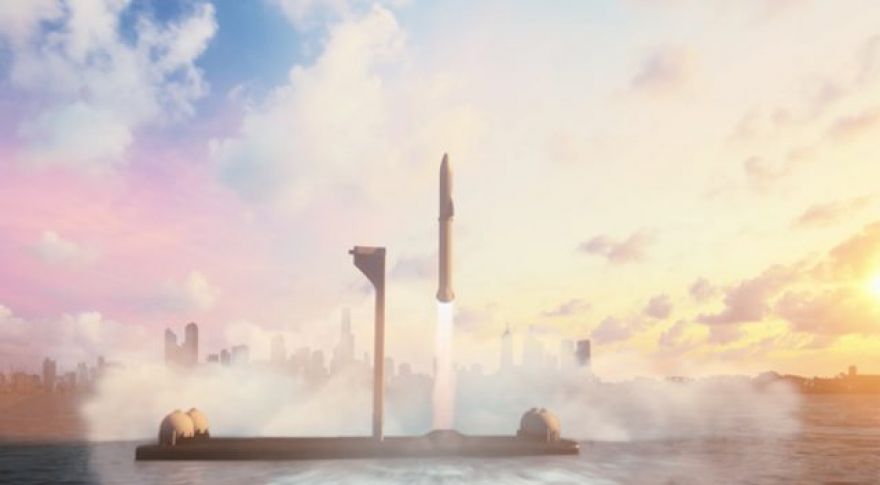
SpaceX’s BFR Vehicle Is Already Taking Shape
SpaceX has big plans for Mars, some of which seem profoundly difficult to accomplish. The company has a goal of building a colony of 1 million people on Mars in the next few decades. The chance that SpaceX can reach the red planet and begin colonization drops to zero if it can’t get a larger, more powerful rocket up and running. It’s making good progress, though. Elon Musk recently revealed tooling for the BFR, and it’s big.
Announced in September 2017, (which stands for Big Falcon Rocket) will eventually take over from the Falcon 9 and Falcon Heavy rockets.
According to Musk’s recent Instagram post, the first tooling segment for the BFR is done. As proof, Musk provided a picture that really gets across how huge the rocket will be upon completion. What we see is a giant metal cylinder next to a Tesla for scale. Keep in mind, the Tesla that SpaceX launched atop the Falcon Heavy barely fit inside its payload fairing. The BFR will be nine meters wide (48 feet), which dwarfs the 3.7 meter Falcon 9.
A post shared by (@elonmusk) on
What you’re looking at in this photo is not actually a piece of the rocket, which Musk didn’t really explain in his post. This is “the main body tool” that SpaceX will use to fabricate the rocket from carbon fiber composite materials that are lighter than traditional materials. Flexible resin sheets of carbon fiber will be layered on the tool and then heated to cure them. After heating, you’re left with a solid section of rocket fuselage. It’s essentially a carbon fiber jig.
Elon Musk has said he wants to do the first test flights of the BFR in . It could be ready for cargo missions to Mars as early as 2022, and manned missions could follow. SpaceX is pushing an aggressive timeline for sending humans to Mars, but there’s still a lot we don’t know about how people will cope over the long haul on an alien world. If our frail biological forms can handle it, though, the BFR should be ready to fly us to Mars sooner rather than later.