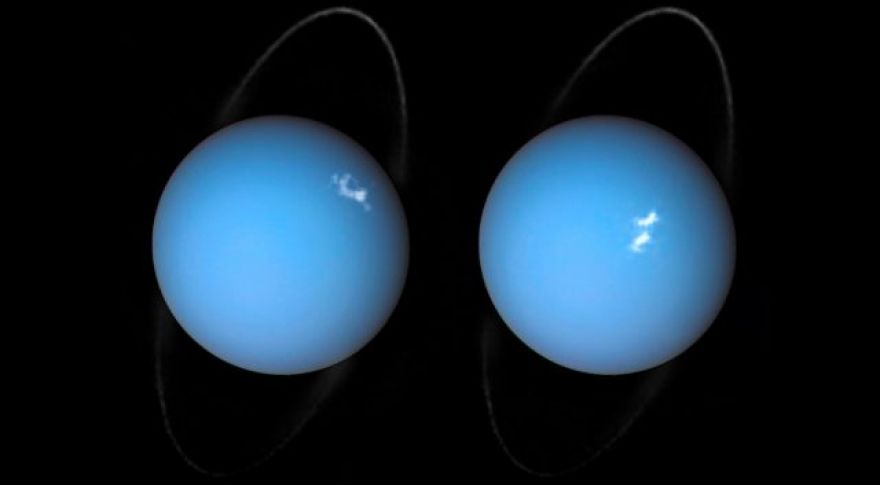
Scientists Confirm Uranus Smells Terrible
Should astronauts ever make a trip to Uranus, they’ll want to hold their breath. Scientists have confirmed that smells really bad. That’s not a joke — well it is, but it’s also a true fact about the seventh planet in our solar system. The clouds of the gas giant if you could take a sniff. Of course, you’d have much bigger problems if you were breathing the atmosphere on Uranus. Note: there will be no further jokes in this article, but that won’t stop it from being funny.
Earthlings have sent probes to the gas giants Saturn and Jupiter.
If you found yourself on Uranus, you’d first notice that it’s -228 degrees Fahrenheit (-200 Celsius) and that you’re dead. If you weren’t dead, the pervasive stench of rotten eggs would make you wish you were. That’s because one of the main constituents of Uranus’ clouds is hydrogen sulfide.
Uranus compared to Earth.
Planetary scientists have wondered for years if the atmosphere on Uranus features ammonia ice like Jupiter and Saturn. As it turns out, it’s hydrogen sulfide ice. The researchers made this smelly discovery with the aid of the Near-Infrared Integral Field Spectrometer (NIFS) instrument on the Gemini North telescope in Hawaii. The telescope analyzed sunlight reflected off Uranus, noting a strong signal indicating the presence of hydrogen sulfide. Only a fraction of the chemical remains in a gaseous state in the cloud tops, which made it difficult to confirm from here on Earth.
Uranus and Neptune, the so-called “ice giants” of the solar system, both formed further from the sun than Jupiter and Saturn. That accounts for the different composition. It could mean that Neptune, too, smells like rotten eggs. That’s not yet confirmed, and it’s not as funny anyway. We won’t know just how bad either planet smells until someone can send a mission there to sample the unpleasant atmosphere.