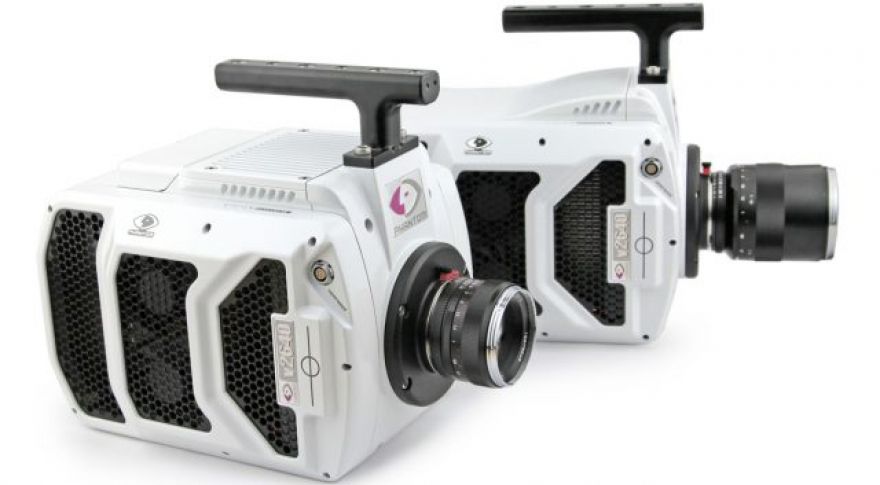
Phantom v2640 High-Speed Camera Can Film 11,750fps in Full HD
Vision Research isn’t in the business of making boring old “regular” cameras. It’s the leading maker of high-speed digital cameras, and is really something else. This camera records at greater-than-HD resolution, but that’s not the impressive part. No, the impressive part is that it records at greater than HD resolution at a mind-boggling 6,600 frames per second. You can push it even higher at lower resolutions.
The Phantom v2640 has a 4MP CMOS image sensor, which might not sound like a lot. However, it’s capable of capturing at the full resolution of that sensor at the aforementioned 6,600fps. That’s a resolution of 2048 x 1952.
Vision Research offers the Phantom v2640 in both color and monochrome versions. The offers a dynamic range of 64dB — that’s over ten stops. The monochrome version has a higher ISO of 16,000, making it better for extreme low-light in the so-called “binning” mode. The color sensor is closer to the ISO you’d expect on a regular camera at 3,200.
The internal storage is configurable at the time of purchase with 72GB, 144GB, and 288GB options. Even the maximum storage option won’t hold a ton of video when you’re recording at thousands of frames per second. So, the camera also supports Vision Research’s CineMag IV swappable high-speed storage disks for an additional 1-2TB of space.
You can get PC accessories to read the CineMags like you would an SD card from a normal camera, but the camera also supports 10Gbps direct Ethernet transfers via the included cable. That’s not a standard cable, though. One end is a proprietary Fischer plug and the other is Ethernet.
The Phantom v2640 isn’t terribly portable with a weight of 17 pounds, but it does come with a custom Pelican hard case for travel. That’s really the least Vision Research can do when you buy the camera — it’s extremely expensive. The base model with just 72GB of storage runs $135,000 and the best model costs $175,000. A single 1TB CineMag IV will run you almost $12,000. None of that should come as a shock, as the Phantom v2640 isn’t exactly a consumer device. It’s aimed mostly at filmmakers and researchers.