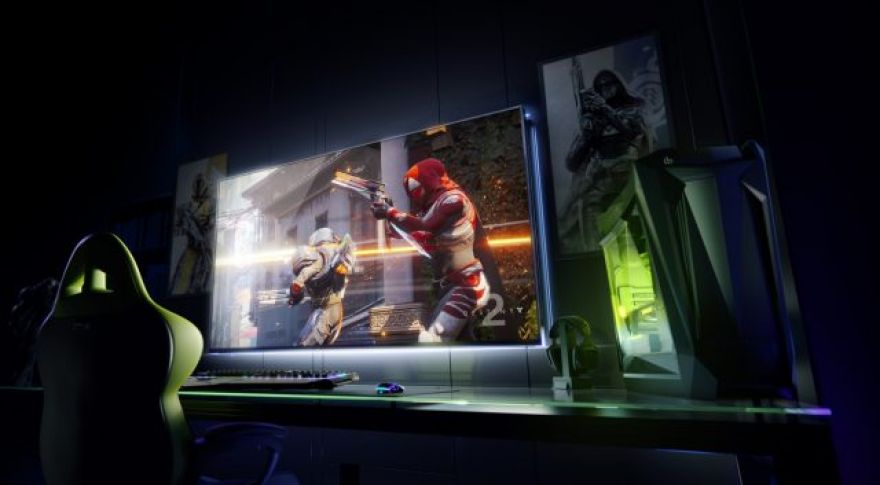
Nvidia Goes All-In On G-Sync With New ‘BFGD’ Ultra-High-End Displays
At CES 2018, Nvidia announced a new line of gaming monitors designed to round up and deliver every single high-end feature you can buy in a monitor or television today. The company’s new BFGD monitors — the acronym stands for Big Format Game Display, obviously, and not the kind of profanity-fueled phrase that might lead one to label such a display a “BFGD Screen” — are serious business, as the saying goes.
All of the partner displays from Acer, Asus, and HP are 65-inch panels that support up to 120Hz refresh rates and HDR with up to 1,000 nits of brightness.
Supported resolution and aspect ratios are a bit fuzzy at the moment. Nvidia’s repeatedly calls out its BFGD displays as being 4K panels @ 120Hz, but it also makes reference to 3440×1440 panels when it writes: “[W]e’ve been working for over two years with leading panel producer AU Optronics to create and perfect 4K and 3440×1440 G-SYNC HDR displays.” There’s no word on which models from which companies support Ultrawide and which are true 4K panels.
There are advantages to both formats, however. A standard 16:9 4K panel gives you native 4K content display and will show movies with no pillar or letter boxing. A 3440×1440 panel gives you a wide angle view of the action with better peripheral visibility for gaming while the lower resolution will help your GPU keep up with the on-screen action. Ultimately, this comes down to personal preference for higher resolution and 16:9 or lower resolutions and a wider screen.
It’s not clear if these new panels conform to the VESA . DisplayHDR-1000 is the highest defined category of HDR displays VESA has released, and the reference Nvidia makes to the DCI-P3 color gamut further suggests we’ll see DisplayHDR-1000 compatibility as part of these panels (VESA mandates 90 percent of the DCI-P3 color space for all DisplayHDR-600 and DisplayHDR-1000 monitors).
Just a few weeks ago, we noted that we’re finally starting to see monitors that pack in support for all top-end features rather than picking and choosing which you get. That future is a bit closer than we thought, though between Nvidia’s fees for G-Sync hardware and the cost of a built-in Nvidia Shield (plus the inherent cost of a low-latency, high-end, 120Hz-capable, 4K panel), we wouldn’t count on picking these up at a discount sale. “BFGD” — the acronym that totally couldn’t be used in partnership with any kind of profanity to refer to the display — also couldn’t possibly be used to refer to the final price.
(Okay, seriously, we don’t know what they’re going to cost yet, and one can dream of $500 price points, but if they come in that cheap I’ll consider eating my hat).