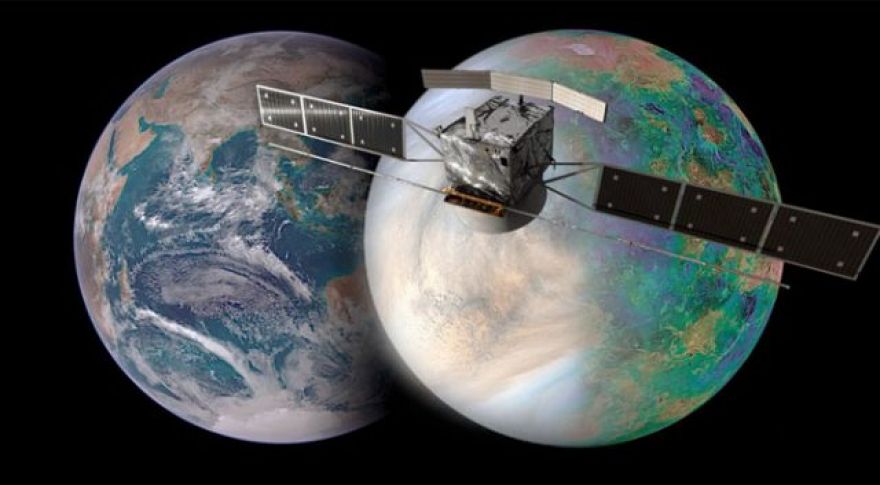
New EnVision Mission Will Study Venus Alongside NASA Probes
Planets like Mars and Jupiter have been the target of numerous high-profile robotic missions in the last few years, but Venus is starting to get the attention it deserves. Just a week after NASA to study Earth’s sister planet, the European Space Agency (ESA) has . The EnVision spacecraft won’t head off to Venus for about a decade, but once there, it could help scientists understand why Venus is a corrosive hellscape and Earth is a lush garden world.
We often talk about how challenging it is to land spacecraft on Mars, but Venus is even more challenging. Well, not the landing part, but surviving.
Currently, the ESA projects EnVision will launch in May 2032, arriving at Venus in August 2033. It will use the planet’s atmosphere to aerobrake, reaching its final science orbit by 2035. The ESA didn’t say how much the mission would cost, but as a “medium-class” science mission, the cost should be somewhere in the neighborhood of €500 million (about $610 million).
While in orbit of Venus, EnVision will use two different radar instruments to scan the planet’s surface. They will also be able to probe just below the surface for evidence of geological processes like lava flows and buried craters. Meanwhile, the probe’s spectroscopy suite will analyze rock and atmospheric composition. In the end, scientists hope to learn whether the planet is still geologically active.
Scientists believe that Venus was once more Earth-like. The presence of certain heavy water isotopes in the atmosphere suggests the world once had more water molecules. If that water was liquid, it could have provided a home for life. Of course, there are hints something might still live on Venus. Last year, researchers said the planet’s atmosphere might , which could point to active biological processes. While subsequent analyses have cast doubt on this, it’s probably not a coincidence that everyone is rushing to get to Venus all of a sudden.
Now read: