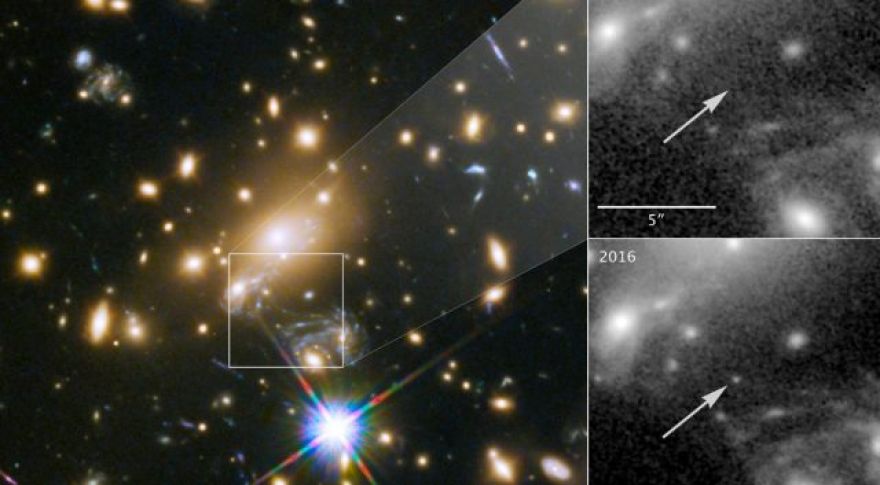
Hubble Detects Most Distant Star Ever
The Space Telescope is getting on toward the end of its useful life, but this instrument is still making breakthrough discoveries and setting records. A series of observations in 2016 happened to spot an unexpected object in the sky, and that object turns out to be the most distant star ever observed by at least 100 times. This star appeared , meaning it existed when the universe was just a third of its current age.
Astrophysicist Patrick Kelly from the University of Minnesota wasn’t looking for the most distant star ever discovered. Instead, Kelly’s team was conducting observations of an ancient supernova called SN Refsdal.
While collecting data on SN Refsdal, Hubble detected a blip that turned out to be a star passing along the edge of the lensed region. The star’s official designation is MACS J1149+2223 Lensed Star 1, which isn’t very snappy. Astronomers have nicknamed it “Icarus,” which is much better. Icarus is a blue supergiant star. The team knew it was a star and not another supernova because its temperature did not fluctuate over time. The star was much larger, hotter, and brighter than our sun, though.
Icarus is not the most distant object ever detected, but it’s the most distant star. At distances measured in billions of light years, even the most powerful telescopes can usually only see galaxies and supernovae — the largest, brightest objects in the universe. We could only see Icarus because of gravitational lensing, but the effect of MACS J1149+2223 doesn’t explain the entire magnification. That galaxy cluster should magnify the background by around 12 times. However, Icarus was magnified by about 2,000 times. That indicates another object, maybe a neutron star or black hole, passed between the galaxy cluster and Icarus. That created a sort of compound gravity lens system.
A blue supergiant star like Icarus burns bright and fast — they only last about million years before exploding in a supernova and collapsing to form a black hole. Since Icarus existed billions of years ago, it has long since undergone that process. Whenever the Webb Telescope finally launches, we could get a peek at even more distant objects. Icarus’ record is safe until , though.