High-Energy Jet Blasting Out of Black Hole Captured in Stunning Image
When last we heard from the Event Horizon Telescope (EHT), the team had just made history by producing the . Now, the EHT has turned its attention to a more distant black hole. This one has a jet of high-energy relativistic material pointed right at Earth, and the EHT has .
The world-famous EHT picture from 2017 featured the supermassive black hole at the heart of M87, a galaxy about 55 million light-years away. The new observation focuses on a galaxy known as 3C279, which is an incredible 5 billion light-years away from Earth. It’s amazing we can see anything at that distance, let alone with this much detail.
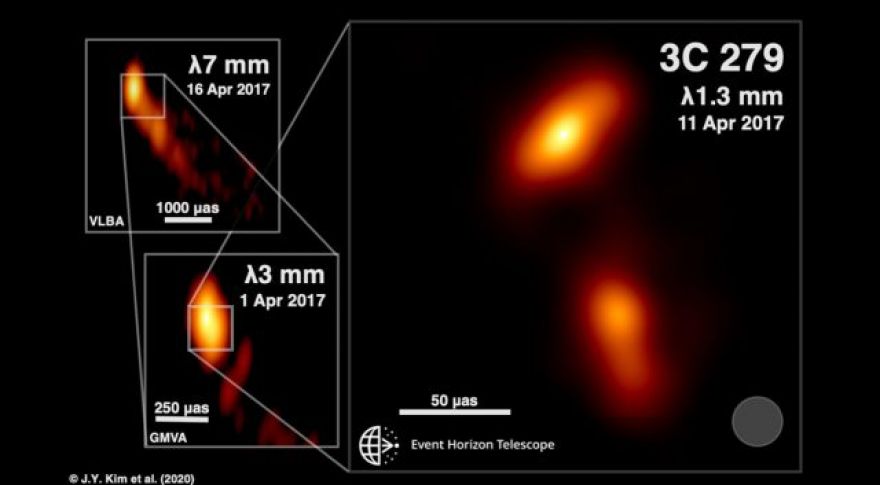
We have never before been able to observe the emissions from a blazar in such detail, but that’s thanks to the EHT’s unique design. It’s not just a single telescope, but rather a combined effort from many radio telescopes around the world including the Atacama Large Millimeter Array, James Clerk Maxwell Telescope, and others. The EHT can resolve details as small as 0.4 light-years across, which is incredible when you’re talking about something 5 billion light-years distant. The image above shows two individual telescope renders on the left and the combined EHT version on the right.
The new EHT image compared with a much wider shot from the Chandra X-ray Observatory.
This image is not entirely what the team expected. The two blobs represent radio emissions from the blazar; the top one is closer to the black hole itself, and the bottom one is farther away. The top section is elongated perpendicular to the rest of the jet, which is in a word, weird. These blobs should be aligned, or at least most scientists expected they would be. The fact that they aren’t could tell us a lot about the forces driving the emissions.
The team has a few hypotheses to explain the unexpected results. The jet could have a slight kink. The jet is only 2 degrees off a trajectory to Earth, so even a small bend could cause this unusual pattern. It’s also possible the intense magnetic field of the blazar has caused the jet to take on a helical or spiral shape. That’s a much more interesting possibility, but it’ll take more observations to know for certain.
Now read: