Facebook Patented a Mechanical Eyeball
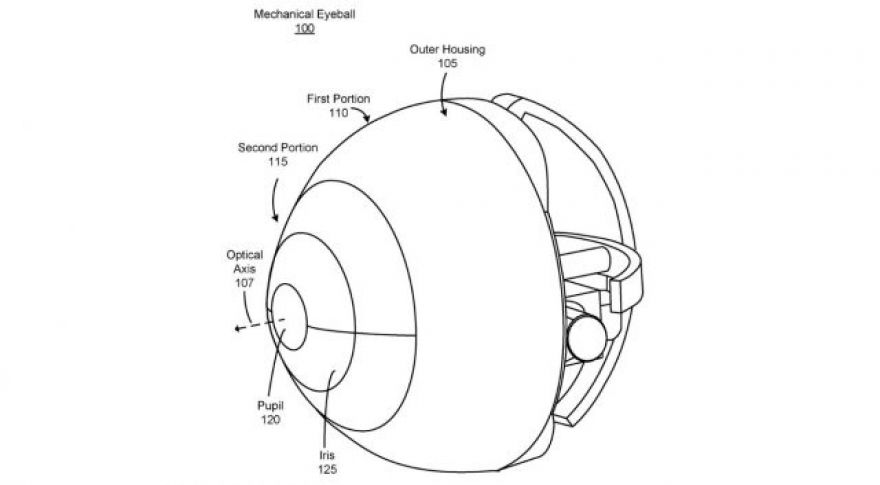
The patent, granted in December and first by Insider, describes in great detail a robotic eye dubbed the “Two-Axis Mechanical Rotatable Eyeball.” The mechanical eye is set on two rotational axes that intersect at a center point and is powered by an external motor, which may or may not exist inside a creepy animatronic head.
The mechanical eye is eerily similar to a human eye both in volume and aesthetic design, which seems to be on purpose given Facebook’s intention to make the eye “appear authentic to an observer.

(Image: United States Patent and Trademark Office)
While Facebook hasn’t come out and said what it intends to use the mechanical eyeball for, context offers a few clues. The patent itself continuously mentions an animatronic device “configured to replicate a human or animal,” which may include skin “resembling human skin” that’s responsible for hiding mechanical components. This could be a reference to a tactile-sensing robot , or ReSkin, developed by Facebook in partnership with Carnegie Mellon University last year. “Skinterfaces” have been something of a research topic of late; researchers back in 2019 demonstrated that could be used to control a PC.
The patent also briefly discusses an animatronic eye tracking system as well as an artificial reality headset, the latter of which is speculated to involve the company’s upcoming Project Cambria VR . Facebook CEO Mark Zuckerberg has publicly stated Project Cambria will contain eye tracking capabilities that allow the user’s virtual avatar to match their eye movements and facial expressions in real time, which would allow this newfangled robotic eye to find its way into the AR/VR space. Similarly, Facebook showed off a haptic glove last November that “mimics the feeling of handling real objects in the virtual world.” We have pretty good reason to believe these projects may be intertwined, given Facebook’s (er, Meta’s) recent commitment to building out a metaverse.
Now Read: